
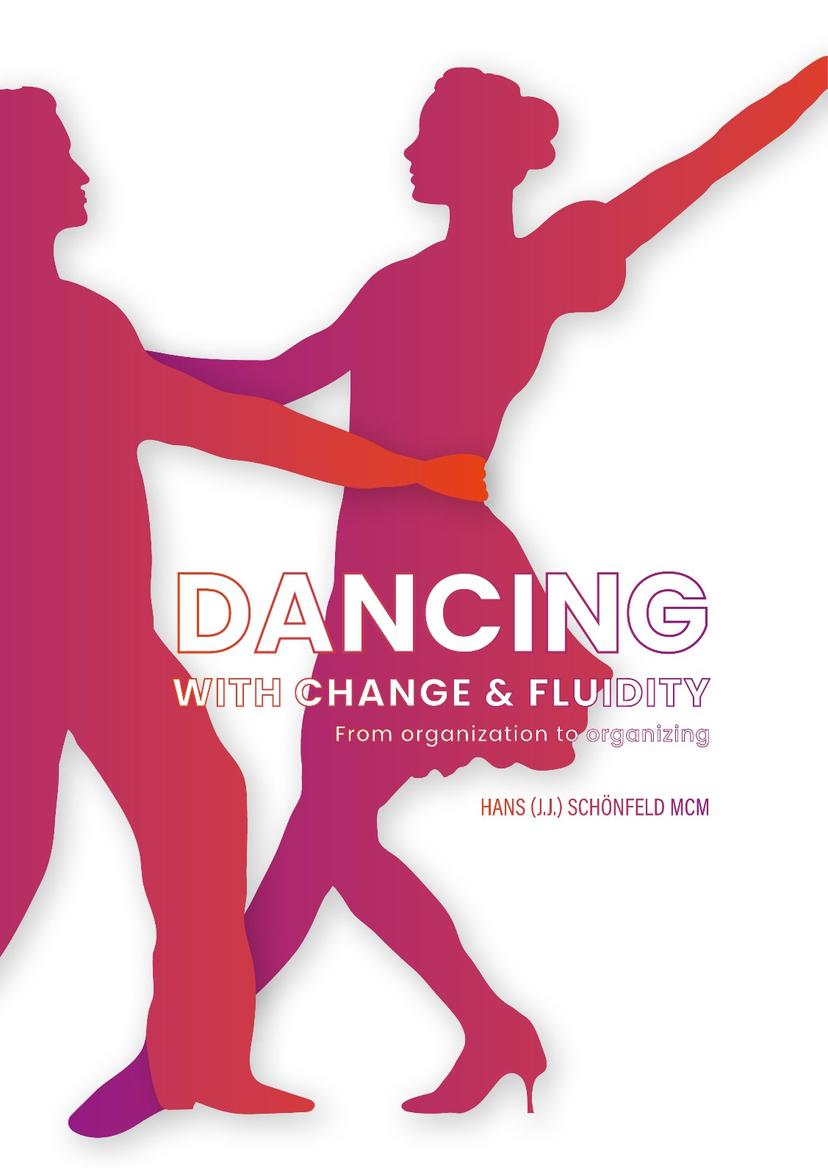
Change was once something with a recognizable beginning and end. An organization set a new course, made a plan, executed that plan and then returned to a period of relative calm. That reality hardly exists anymore. Technology, society, the economy, human behavior and organizational forms influence one another continuously. New developments arise simultaneously, reinforce each other and change character again while being applied.
Hans Schönfeld calls this reality fluidity. Fluidity means that boundaries blur and existing categories flow into one another. Work and private life, people and technology, producer and consumer, local and global, fixed and flexible: they are less and less clearly separated worlds. Moreover, old structures do not disappear immediately when something new arises. They continue to exist alongside new ways of working and make reality layered, sometimes contradictory and hard to fathom.
Organizations resemble structures made up of departments, functions, processes, powers and formal lines. When changes occur, the structure, or part of it, is redesigned: a new structure, a new organization chart or a new governance model. In a fluid environment, however, one organizes from the awareness that the organization is never really finished and that change is a continuous process. Attention must therefore shift from the organization to continuous organizing. Organizing is an ongoing process in which people, technology, information, relationships and circumstances come together again and again. Direction, collaboration and structure arise while acting. They can be fixed temporarily, but must be able to change again as soon as the context demands it.
That does not mean that plans, processes and rules become useless. Organizations need stability to function reliably. At the same time they must keep room for renewal, experiment and adaptation. The art is to develop both capabilities side by side. Schönfeld describes this as ambidexterity: the ability to control and to discover, to exploit and to explore.
Anyone who wants to deal well with fluidity must first learn to see it. Mechanistic thinking starts from predictability, clear causes and controllable processes. The informational worldview looks more at interactions, networks, feedback and patterns that emerge along the way. Both perspectives have value. The problem arises when an organization keeps steering exclusively from the first perspective while its environment already functions as a dynamic network. Then plans are overtaken by reality faster, decision-making takes too long and organizations solve problems that have meanwhile changed shape.
The book therefore helps readers look at change differently. Not every development can be fully understood in advance. Sometimes insight only arises by acting, observing and learning together. That requires curiosity, the ability to explore several possible futures and the willingness to question assumptions again.
Central to the book are eight interconnected capabilities that help organizations deal with a moving reality.
- Digital fitness increasingly determines how fast an organization can process information, make connections and seize new possibilities. This is not only about software and data.
- The collaboration between people and intelligent systems, including AI and cobots, also takes an ever larger place.
- Ambidexterity helps organizations balance continuity and renewal. They must deliver existing services reliably and discover new forms at the same time. Too much control leads to rigidity; too much experiment can lead to fragmentation and unpredictability.
- In addition, it is necessary to perceive the context sharply, explore several images of the future, innovate creatively and actively collaborate in ecosystems.
- Decisions must be taken faster and closer to the action.
- Ideas must be realized smoothly and the organization must keep improving continuously.
These capabilities function as parts of a living system. Weakness in one area affects the others. Digital technology, for example, has little value when decision-making remains slow. Experimenting yields little when experiences are not shared. Collaboration in a network only works when parties trust each other and can give meaning to what they want to achieve together.
Fluidity also asks something of people. New structures or technologies are insufficient when people hold on to old patterns of thinking. Schönfeld distinguishes five human dimensions: being, thinking, relating, collaborating and acting.
- Being is about identity, awareness and the way someone is present in a changing environment.
- Thinking concerns the ability to let go of assumptions and to examine alternative explanations.
- Relating is about entering into meaningful connections.
- Collaborating requires the ability to combine different perspectives and talents.
- Acting means that insights are actually converted into experiments, decisions and movement.
A fluid dancer does not try to bring reality to a complete standstill in order to control it. He or she learns to move along without losing direction and responsibility. That requires a combination of courage and humility: daring to act while not everything is known yet, and being willing to adjust the chosen direction when new information becomes available. The leader can no longer always be the one who knows the future and designs the entire change process. Leadership becomes more like choreography: making room, setting a rhythm, stimulating connections and making sure people can move together.
Executives and leaders must be visibly involved, enable fast decision-making and invest in strong teams and networks. They must bring different forms of knowledge together and accept that meaning and value sometimes only emerge during the process. Good governance remains necessary, but takes on a more dynamic character. Supervision and steering must offer enough grip without stifling the movement.
Dancing with Change & Fluidity is written for executives, supervisory board members, managers, consultants, professionals, students and anyone involved in digital transformation, organizational development and societal change. The strength of the book lies in the connection between technology, organizational science and human action. Digital developments are placed in a broader societal context. Organizing is approached as an interplay of structures, relationships, information, behavior and meaning. In this way the book invites the reader to look beyond the next reorganization or technological implementation.
This book invites you not only to undergo or control change, but to dance with it. Not out of recklessness, but out of curiosity, craftsmanship and trust. The future belongs to people and organizations that have enough grip to act reliably and enough agility to reinvent themselves again and again.
About the authors
Hans Schönfeld MCM
Choreographer of movement, author, and initiator.
Initiator of the network. Author of several recent books and articles on fit, fast, and dynamic organizing.
LinkedInDiscussions about this
Have a question about this topic, or an experience to share? Start a discussion; it stays linked to this page.
Comments on this book
No comments yet
Be the first to comment.
Want to comment? Log in or join for free.