Go Flow
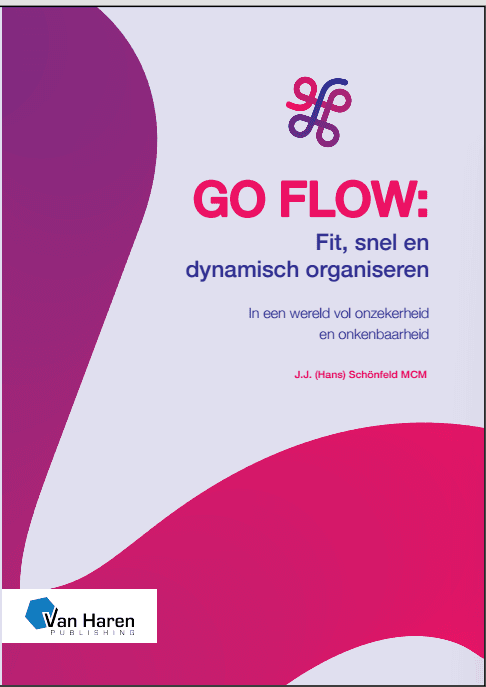
Fit, fast and dynamic organizing in a world full of uncertainty and unknowability
Hans Schönfeld
Organizations have boundaries between departments, functions and responsibilities. Between public and private, client and contractor, people and technology, policy and execution. For a long time those boundaries offered overview, stability and something to hold on to. But more and more of those familiar dividing lines are beginning to dissolve.
Digitalization connects events, organizations and people on an unprecedented scale. Artificial intelligence changes the way we process information, make decisions and carry out work. Public challenges do not stop at the boundary of a single government organization. Companies operate within ecosystems of partners, platforms, suppliers and users. The workplace can be at home, at the office or on the road. Human and artificial intelligence increasingly work alongside and with each other.
Hans Schönfeld calls this phenomenon fluidity: boundaries and categories that seemed self-evident for a long time lose their fixed form. Out of that dissolving, flow arises: a continuous movement in which developments influence and accelerate one another. That has profound consequences for the way we organize.
Many organizations still treat change as a temporary event. A problem arises or there is an ambition. The current situation is analyzed and a desired situation is designed. A project, program or transformation then has to take the organization from A to B. But what happens when B changes during the journey? What do we do when technology, legislation, societal expectations or geopolitical relations move faster than the program? And what happens when a possibility C suddenly emerges that could not have been known at the start? Then not only the route and the landscape move, but the destination as well.
The Go Flow Network and this book examine how organizations and people can keep acting when change becomes a permanent condition. The book makes an important distinction between uncertainty and unknowability. Under uncertainty we know several possible developments, but not which one will become reality. Scenarios, forecasting, probability calculations and risk management can help there. Under unknowability, relevant future possibilities do not yet exist at the moment of acting, or we cannot yet oversee them. The attacks of 11 September, the coronavirus pandemic and the unexpectedly rapid breakthrough of generative AI show how far-reaching such events can be.
No plan can fully prepare an organization for the unknowable. An organization can, however, develop into one that is fit enough to respond as soon as the unexpected presents itself.
Fitness does not mean that everything must change all the time. A top athlete does not run all day to stay fit either. Fitness means that the required capability is available when circumstances call for it: being able to accelerate when speed is needed, slow down when care becomes more important, standardize where stability adds value and improvise where uncertainty prevails. The central question shifts from how we realize what we agreed to how we make sure that what we realize still fits the world in which it ultimately has to function.
The book works this idea out in eight organizational and five personal fitness areas.
- The organizational side covers the ability to perceive developments, create new possibilities, decide quickly and carefully, realize ideas, improve continuously, connect exploration with production, act digitally responsibly and collaborate beyond one's own boundaries.
- The personal side is about fitness in being, thinking, relating, collaborating and acting. Because an organization does not become more agile by changing processes, structures and technology alone.
These thirteen fitness areas are not a checklist and do not lead to a single overall score. An organization can be highly developed digitally and at the same time struggle with collaboration. A board can perceive future developments sharply, yet fail to get moving because of slow decision-making. A leader can rationally understand that uncertainty is inevitable and still keep looking for control and false certainty in practice. Go Flow is therefore about the coherence between different capabilities. Fitness is not an end state that can be reached once and then retained. What is sufficient today may fall short tomorrow.
Artificial intelligence receives special attention in the book. Where organizations used to rely on periodic reports, samples and lengthy analyses out of necessity, AI makes broader and sometimes almost continuous observation possible. AI can connect information from different sources, help recognize patterns, generate alternatives and support people in knowledge-intensive work. In this way AI contributes to speed, quality, dynamics and fit. An organization that adds AI to a rigid organizational model does not automatically become more agile. It may mainly start doing faster what it was already doing yesterday.
The essential question is therefore how human and artificial intelligence can jointly contribute to the ability to perceive, understand, learn, choose and act. Human judgment, ethics, responsibility and meaning remain indispensable.
Go Flow does not declare existing methods redundant. Control, Lean, Agile, Scrum, DevOps, SAFe, project management and risk management contain valuable knowledge. The danger arises when a method becomes more important than the changing reality. Go Flow therefore adds an essential overarching question: can the organization continuously determine which approach fits the current situation? Following that idea, the Go Flow approach delivers more than an agreed result. It also leaves behind an organization that is better able to absorb the next, still unknown change.
The book is written for executives and boards who want to prepare their organization for changes that cannot be fully predicted. For supervisory board members and regulators who want to signal and anticipate earlier, alongside accountability after the fact. For project, program and change managers who experience that the intended end point can shift during execution. For Agile, Scrum, SAFe and DevOps professionals who want to broaden the adaptivity of teams to strategy, governance and the entire organization.
It is equally an invitation to researchers, students, professionals, entrepreneurs and policymakers. Go Flow is a growing quest in which scientific insights, art, practical experience, technology and different perspectives are connected. That quest is shaped together with others within the Go Flow Network: a community in which executives, professionals, researchers, students and organizations jointly build a Body of Knowledge, Perspectives & Methods. Not a collection of definitive answers, but an environment in which insights are examined, tested, supplemented and improved.
Go Flow is recommended for anyone who senses that more plans, rules and control no longer offer a complete answer to today's world. The book helps you recognize fluidity, examine uncertainty and unknowability, and develop the organizational and personal fitness needed to keep acting. Do not wait for the moment when the world becomes stable again. Examine what movement is needed now, make room for learning and increase the ability of your people and organization to face any future.
About the authors
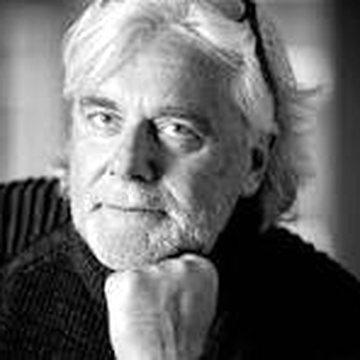
Hans Schönfeld MCM
Choreographer of movement, author, and initiator.
Initiator of the network. Author of several recent books and articles on fit, fast, and dynamic organizing.
LinkedInDiscussions about this
Have a question about this topic, or an experience to share? Start a discussion; it stays linked to this page.
Comments on this book
No comments yet
Be the first to comment.
Want to comment? Log in or join for free.