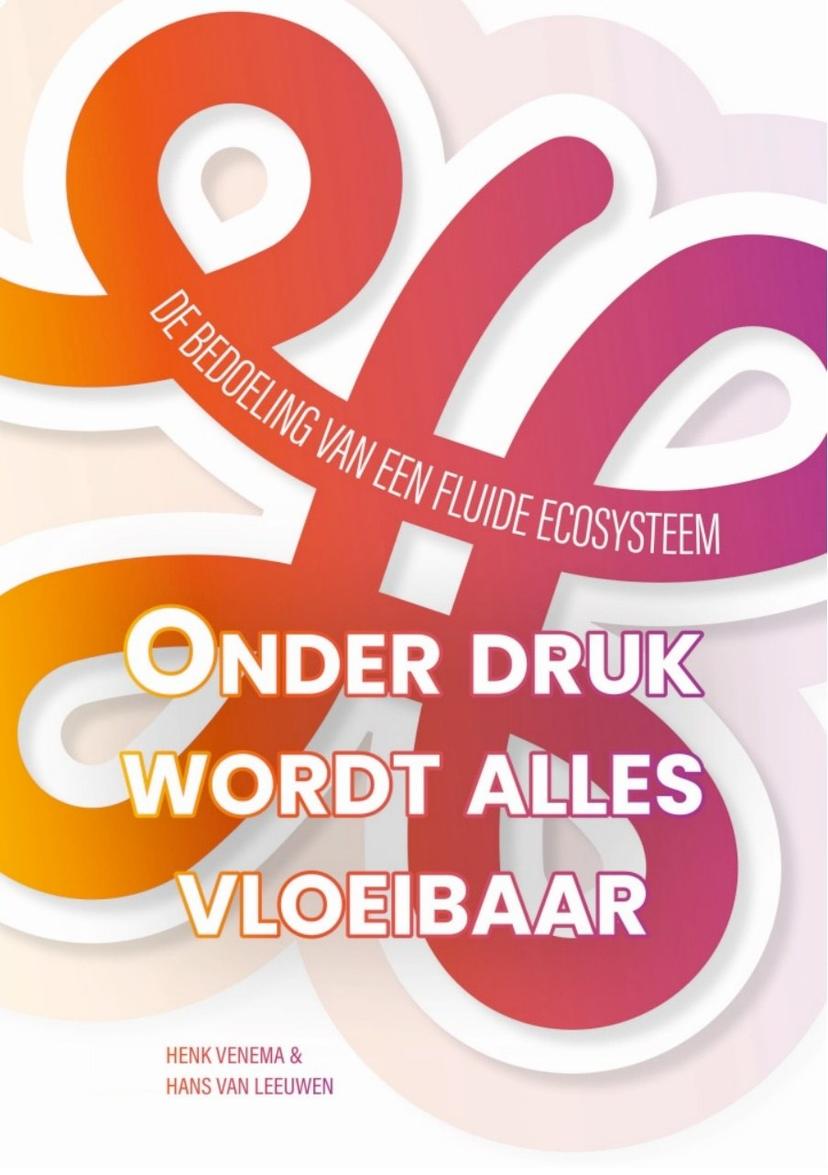
Onder druk wordt alles vloeibaar
The purpose of a fluid ecosystem
Henk Venema & Hans van Leeuwen
Organizations increasingly face issues they can no longer solve on their own, or no longer want to. The world develops faster than policy and processes can keep up with. Cyber threats do not stop at national or organizational borders. Societal challenges around care, safety, energy and climate affect entire value chains. Shortages of people, knowledge and resources force organizations to look at collaboration differently.
Many established organizations struggle with a substantial legacy that stands in the way of organizational fitness. Processes have become ever more complicated over the years, systems are hard to adapt and decision-making is slow, running through several hierarchical layers.
Boundaries, roles, technologies and interests that used to be separate increasingly flow into one another (fluidity/flow). Developments not only follow each other faster, they also reinforce and influence one another. As a result, the environment, the challenge and sometimes even the desired end result change while organizations are already under way. The central question of Onder druk wordt alles vloeibaar is therefore not only how organizations can become more agile; the authors go deeper into collaboration fitness and the personal fitness to relate. They examine how organizations, with suitable partners, can deal with issues that exceed their individual capability, knowledge and mandate.
Traditional organizations are usually built around one or more clearly defined tasks. They have their own strategy, structure, budget, governance and accountability model. Complex issues, however, do not respect organization charts. A problem in healthcare can be a social, financial, technological and administrative problem at the same time. A digital innovation affects not only the IT department, but also service delivery, legislation, supervision, behavior, leadership and the trust of citizens or customers. No single party involved then has the full picture of the problem or all the required competencies.
Collaboration is no longer an additional activity today, but a necessary condition for achieving results. Within the Ego perspective, every organization reasons mainly from its own mandate, powers, resources and interests. Within the Eco perspective, the shared societal or economic value is central. The participants remain recognizable organizations, but connect their people, knowledge, data, technology and capacity to act around a shared purpose.
A fluid ecosystem is thus a dynamic partnership that forms around a concrete purpose or challenge. Its composition is not fixed forever. Parties can join when their knowledge, resources or powers are needed and make room again when their contribution becomes less relevant. The strength of such an ecosystem does not lie in building a new, heavy organization on top of the existing ones. The strength comes from connecting the available competencies at the right moment. Form follows the challenge.
Very diverse participants can be involved: government organizations, companies, knowledge institutions, societal partners, suppliers, independent professionals, citizens and users. AI, data, digital platforms, agents and other technological facilities can also become part of the joint organizing capacity.
The collaboration is held together by a common purpose: the reason the ecosystem exists. That purpose gives direction without fixing the entire route in advance. The participants agree on what value they want to create together, what contribution each can make and how they deal with decision-making, responsibilities, risks and returns. A fluid ecosystem requires trust, transparency and equality for this. Participants must be able to look beyond the interest of their own organization. They must dare to share information, make differences discussable and learn together from what happens during execution.
According to Venema and Van Leeuwen, the transition to a fluid ecosystem requires developing fitness in three dimensions: fitness in organizing, digitalization and people.
- The organizational dimension concerns, among other things, strategy, governance, processes, value streams, decision-making and the design of collaboration. Organizations must offer enough structure to be able to act jointly, but prevent that structure from stifling the movement again.
- The digital dimension goes further than introducing new tools. Data, AI, cloud technology, digital sovereignty and modern ways of developing increasingly determine how fast an ecosystem can perceive, decide and deliver value. Outdated technology and long development cycles can be a major brake on collaboration.
- The human dimension is ultimately decisive. People must want, be able and be allowed to realize the change. That requires talent, leadership, psychological safety, connection and a culture of learning. A technically advanced ecosystem without trust and shared meaning will not function sustainably.
The three dimensions cannot be developed separately. New technology does not work when processes and powers do not move along. A new structure yields little when people keep acting from old interests. Committed professionals cannot realize their value when systems and rules constantly restrict them.
To set a fluid ecosystem in motion, the authors present a cyclical approach with four steps:
- Awareness – becoming aware. Using the Go Flow approach to explore, fit, fast and dynamically, what may be going on in your organization (across the nine fitness areas). A quick phase of awareness that should lead to a shared understanding of the developments.
- Assessment – establishing. Quickly establishing where the main challenges lie, based on an assessment of the fitnesses of the organization or the ecosystem. Fast decision-making on where adjustments are most needed.
- Adjustment – adjusting. Adjustments based on small, iterative (short-cycle) mini-plans, designed together with employees and/or partners.
- Action – doing. The mini-steps are carried out; lessons are drawn from what happens in practice. Those experiences then feed a new mini-plan.
The four A's form the rhythmic heartbeat of an ecosystem. The authors reason from the Go Flow principles of fit, fast and dynamic organizing. The ecosystem should not spend most of its time on analyses, structures and plans. Awareness, assessment and adjustment must proceed quickly in order to turn energy into actual value creation. Learning largely takes place while doing.
Over the past decades organizations have invested heavily in Lean, Agile, Scrum, DevOps, SAFe and digital transformation. Those investments remain valuable. The book presents the fluid ecosystem as the next development: from optimizing within one's own organization to continuously creating value across organizational boundaries.
The book is relevant for commercial enterprises as well as public organizations. Banks, healthcare institutions, executive agencies, regulators, technology companies and societal partners are all confronted with issues that are part of a larger system. Their success depends ever more strongly on the quality of the interplay.
The book is intended for executives and leaders who notice that their organization can no longer solve complex challenges alone. For program and transition managers who have to organize collaboration across organizational boundaries. For policymakers and public professionals who want to realize societal value within chains and systems. And for consultants, architects, IT professionals and change agents who want to connect digitalization, people and organization.
The book combines a broad reflection on fluidity with a concrete solution direction, a central organizational case and various practical examples. It thereby invites readers not only to talk about ecosystems, but to actually form them and set them in motion. Under pressure, everything can become fluid. The challenge is not to undergo that movement, but to give it direction together.
Discussions about this
Have a question about this topic, or an experience to share? Start a discussion; it stays linked to this page.
Comments on this book
No comments yet
Be the first to comment.
Want to comment? Log in or join for free.